
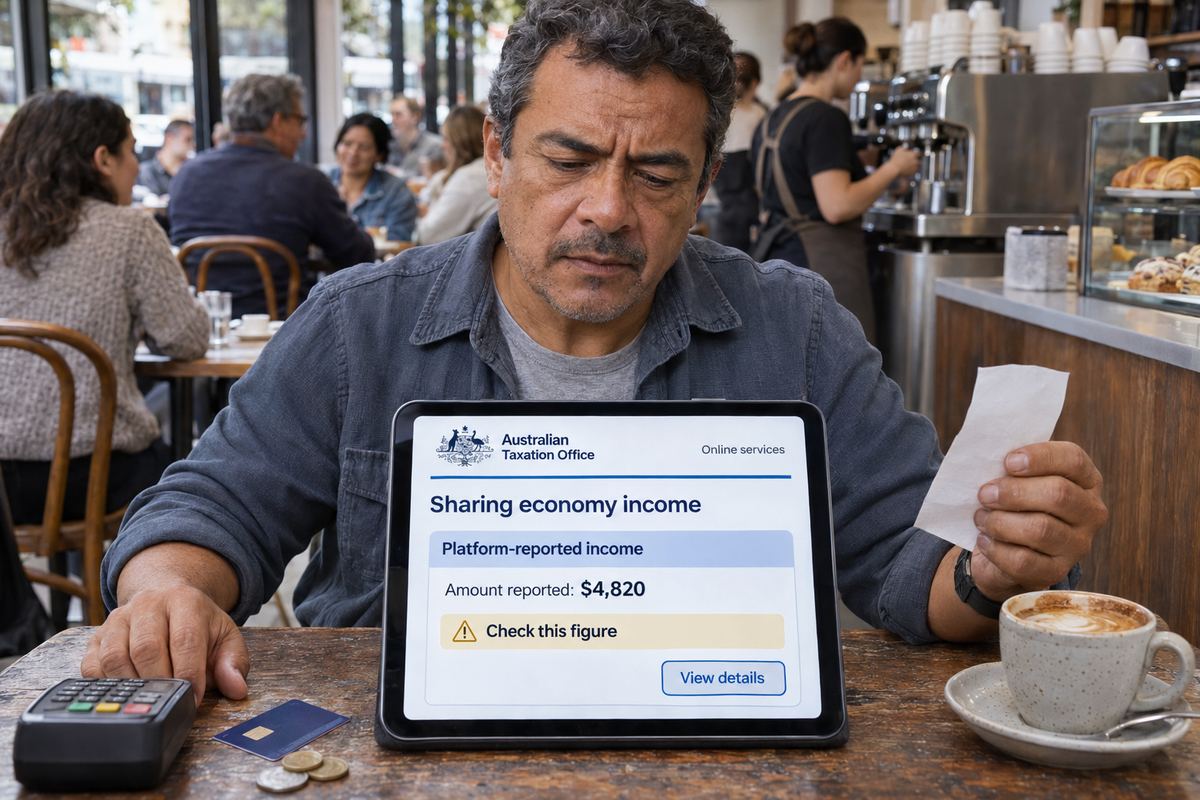
You drive for a ride app, rent out a spare room, hire out your car or tools, or pick up tasks and deliveries through a platform. Then you hear the platform now tells the ATO what it paid you. Or a letter arrives saying the income on your return does not match information the ATO holds.
The short version: since 1 July 2024, most platforms that take bookings for services, stays, rides and asset hire in Australia report what passed through them to the ATO, twice a year, with your name, contact details and bank account attached. That data does not fill in your return for you. It is used to check that what you lodged matches. So the fix is almost always the same: declare the income yourself, in the right place, with your own records to back the number.
Who reports, from when, and what they send
The rule is the Sharing Economy Reporting Regime, which the ATO shortens to SERR. The obligation sits with the operator of the electronic distribution platform, the app or website that connects you with customers. You don't lodge anything under SERR yourself.
It started in two stages. Reporting began on 1 July 2023 for taxi travel, including ride-sourcing, and for short-term accommodation. From 1 July 2024 it was extended to all other reportable transactions. For the first group, the ATO says the trigger is when the platform pays you, so a payment made on or after 1 July 2023 is reported even if the booking happened earlier.
Platforms report twice a year: by 31 January for transactions from 1 July to 31 December, and by 31 July for transactions from 1 January to 30 June. By the time you lodge your return for a financial year, the ATO may already hold both halves of that year from your platforms.
For an individual, the ATO's reporting guide lists personal details (first name, surname and date of birth), contact details (address, email and phone number) and financial details such as your bank account. For a business it is the ABN or similar identifier and the business or trading name instead of the personal details.
For the money, the report covers the amounts paid, GST, fees and commissions. The ATO describes the reported figure as gross income: the total paid for bookings, digital goods or services during the period, including GST and commissions. Keep that in mind when you compare it with your bank account, because the platform's fee was taken out before you were paid and still counts in the reported total.
Sell from a free OneSol page through your own Stripe or PayPal account, so every sale lands in one account you can match against your records. Free plan included.Start free →What is covered, and what is not
The ATO's own list of sharing economy activities is a useful guide to what platforms report. Its exclusions are where most of the confusion about online shops comes from.
- Covered: ride-sourcing and taxi travel, booked through an app.
- Covered: renting out a room, house or unit through an online platform.
- Covered: sharing assets such as cars, caravans, parking spaces and storage, where you hire them out rather than sell them.
- Covered: providing services through a platform, such as digital work, trade and labour, and delivery. The ATO also lists selling digital goods, such as videos and eBooks.
- Not reported under SERR: transactions that transfer ownership of goods or real property. A physical item sold through an online shop or marketplace falls here.
- Not reported under SERR: financial supplies, such as trading financial securities, and sales of vouchers such as gift cards.
- Not treated as sharing economy at all: online selling or classifieds, crypto asset exchanges, and peer-to-peer finance or crowdfunding.
Selling goods online: the regime is not the whole story
If you sell physical products through an online shop, your sales are outside SERR. That is not the same as being invisible. The ATO runs a separate online selling data-matching program that collects sales data from online marketplaces about sellers whose annual sales reach $12,000 or more. The ATO says that data feeds its risk models and is not used on its own to start automated compliance action.
Whether you have to declare the money depends on what you are doing. The ATO sorts online selling into three groups. If you are in business, the income is assessable and you need to meet the registration rules. If you are not in business but are selling to make money, for example buying items to resell at a profit on weekends, the ATO says the amounts may still be assessable. If you are clearing out your own unwanted things, the ATO's example of someone who sold personal items for $800 concludes that money is not assessable, and the costs are not deductible either.
To tell a business from a hobby, the ATO looks at whether there is a commercial purpose, how regular and organised the activity is, and whether you intend to make a profit. It also says wanting to be in business is not enough on its own; it has to come with real, active effort.
Declaring the income: where it goes on your return
For services and asset hire through a platform, the hobby question changes where the income goes, not whether it counts. The ATO's myTax instructions say amounts received through a digital platform for sharing assets or providing services are assessable even if you are not carrying on a business, and the ATO is clear that platform data does not pre-fill your return. You add it yourself.
- No ABN: include it in the 'Other income' section of your individual return.
- Sole trader with an ABN: include it as business income in the 'Business and professional items' section. Ride-sourcing is treated as a business, so drivers report it here.
- Renting out all or part of your home, or a property through a booking platform: this is rental income and goes in the rent section, not 'Other income'. The ATO says it includes short-term rentals and renting part or all of your home.
- Deductions: you can claim expenses only to the extent they relate to earning that income. For a shared home, the ATO says deductions must be apportioned to exclude private use.
- Keep the platform's earnings statements for each period. They are the easiest way to show where your number came from.
GST: the $75,000 threshold and the ride-sourcing exception
For most businesses, GST registration becomes compulsory when your GST turnover, the current month plus the previous 11 months, is $75,000 or more, or is projected to reach it. Once you are required to register, you have 21 days. Below the threshold, registering is optional.
Ride-sourcing is different. The ATO says the threshold does not apply: you need an ABN and must be registered for GST before your first trip, whatever you earn, and you report GST monthly or quarterly, not annually. The ATO also says it uses platform data to find drivers who are not registered, and may register them, back-date the registration, and ask for the GST on past rides, plus interest and penalties.
Short-term accommodation in your home usually has no GST. The ATO says residential rent is input taxed, so you don't add GST to the charge and can't claim GST credits on related costs. GST only comes into it if you run an enterprise renting out commercial residential premises, such as a commercial boarding house.
If the platform's figure looks wrong
First check whether it is wrong or just measured differently. Because the reported amount is gross, including GST and commissions, it will usually be higher than the payouts that reached your bank. A booking paid in late June but paid out to you in July can also land in a different period from the one you expect.
If it is a real error, such as trips you never did or another person's income under your name, the data came from the platform, so ask the platform to correct what it reported and keep its reply. Then lodge your return with the correct figure from your own records.
If the ATO contacts you about a mismatch, don't ignore it. The ATO says a mismatch does not automatically mean it thinks you have been dishonest. It will give you the details of the matched data and usually up to 28 days to check your records and respond before taking action. Reply before the due date on the letter, quote its reference number, and include evidence such as platform statements and bank records. If you find you did leave income out, the ATO's advice is to correct the mistake by amending your return.
Prevent it next time
Download each platform's earnings statement at the end of June and again in January, when the platforms are preparing their own reports. Note the gross amount, fees and GST separately, and keep platform income apart from your personal spending so it is easy to total. If you are close to $75,000 a year across everything you sell, check the GST rules before you cross it, not after.
Selling direct as well
If you also take bookings or sell directly, a free OneSol page can take payments through your own Stripe or PayPal account, so those sales land in one account you can line up against what the platforms report.