
You sell handmade jewellery from a marketplace shop, a few printable planners, a coaching package or a weekend yoga class, and someone tells you that as a Kleinunternehmer you don't have to charge VAT. Then you search for the limit and find three different numbers on three different sites.
The short answer: yes, an online seller based in Germany can use the Kleinunternehmerregelung (small business scheme) under § 19 UStG, the German VAT Act. Selling online changes nothing about it. What changed is the rule itself. Since 1 January 2025 your sales are exempt from VAT as long as your turnover stayed within 25,000 euro last year and stays within 100,000 euro this year. Anything quoting 22,000 or 50,000 euro was written before that change. This is general information, not tax advice; your Finanzamt (tax office) or a Steuerberater (tax adviser) has the final word on your case.
The two limits since 1 January 2025, and how each test works
§ 19 Absatz 1 UStG sets two conditions, and you need both. The Existenzgründungsportal of the federal economics ministry adds that since 2025 both figures are net amounts, without VAT.
- Previous year: your Gesamtumsatz (total turnover) in the previous calendar year did not exceed 25,000 euro. This is a look-back test with a fixed answer. If last year ended at 25,400 euro, you are out for the whole of this year, even if this year stays tiny. The Federal Ministry of Finance (BMF) spells this out in its guidance of 18 March 2025.
- Current year: your turnover in the current calendar year does not exceed 100,000 euro. This is not a forecast any more. It is checked against the money that actually comes in, and the BMF guidance says the sale that takes you over the line is already taxed normally.
- First year of business: the Existenzgründungsportal says that in the year you start, your Gesamtumsatz may not be more than 25,000 euro. There is no previous year to look back at, so the lower figure is the one that applies.
- If you cross 25,000 euro in your founding year, you switch to normal VAT mid-year. Sales before that point stay exempt; the crossing sale and everything after it are taxed.
What counts toward the limit
§ 19 Absatz 2 UStG defines Gesamtumsatz as the total of your taxable sales calculated 'nach vereinnahmten Entgelten', meaning on the money you actually received, not on invoices you sent. A course you invoiced in December but got paid for in January counts in January.
Everything you sell as a business adds up into one figure: the shop, the digital downloads, the coaching calls and the classes together. Running them through different platforms or payment accounts does not give you a separate limit for each. Two things are left out by the law: certain sales that are VAT-exempt for other reasons (the law lists them by reference to § 4 UStG), and sales of your Anlagevermögen (fixed assets), such as selling the old laptop or sewing machine you used in the business.
What to write on your invoices
As a Kleinunternehmer you must not show VAT on an invoice. The Existenzgründungsportal is blunt about the risk: if you show it anyway, you owe that amount to the tax office, even though you are exempt. Copying a template that has a '19 % MwSt.' line is the classic way this happens.
§ 34a UStDV lets you issue a simplified invoice. It must contain at least:
- Your full name and address, and the full name and address of the customer.
- Your Steuernummer (tax number from the Finanzamt), or your USt-IdNr (VAT ID) or Kleinunternehmer-Identifikationsnummer from the BZSt.
- The date the invoice was issued.
- The quantity and usual name of the goods, or the type and scope of the service.
- The total amount, plus a note that the tax exemption for small businesses under § 19 UStG applies. The law does not prescribe exact words; a line such as 'Steuerbefreiung nach § 19 UStG (Kleinunternehmerregelung)' covers it.
- E-invoicing: the BMF says Kleinunternehmer are exempt from having to issue e-invoices and may always send an ordinary invoice, but like every business they must be able to receive e-invoices from suppliers. An email inbox is enough for that.
Registration: Gewerbeanmeldung, Finanzamt and tax returns
The Kleinunternehmerregelung is a VAT rule. It does not excuse you from registering the business. The Existenzgründungsportal says that anyone who runs a business independently, on their own account and to make a profit generally has to register a Gewerbe at the Gewerbeamt, and that this applies whether you do it as your main job or on the side. Selling crafts or digital products usually falls here.
Freiberufler (the liberal professions) do not register a Gewerbe. They go only to the Finanzamt, no later than four weeks after starting. The portal adds that whether you count as a Freiberufler or a Gewerbetreibender is decided by the authorities, not by you.
Either way, you file the 'Fragebogen zur steuerlichen Erfassung' (tax registration questionnaire) through ELSTER, and that is where you tick that you want to use the Kleinunternehmerregelung. You then get a Steuernummer. § 19 UStG switches off the usual VAT return duties, but the tax office can still ask you to file one. The exemption is about VAT only; it says nothing about income tax.
When you go over the limit
Going over is not a penalty, it is a switch. What it means depends on which limit you crossed.
- Over 100,000 euro in the current year: the sale that crosses the line and every sale after it are taxed under the normal rules. Earlier sales that year stay exempt. From that point you need to charge VAT and issue full invoices.
- Over 25,000 euro by the end of a later year: nothing changes for that year as long as you stayed under 100,000 euro, but you cannot use the exemption in the following calendar year at all.
- Over 25,000 euro in your founding year: you switch mid-year at the sale that crosses 25,000 euro.
- Choosing normal VAT on purpose: § 19 Absatz 3 UStG lets you waive the exemption by telling the Finanzamt. The declaration binds you for at least five calendar years, so think before you do it. One reason people do: as a Kleinunternehmer you cannot reclaim Vorsteuer (the VAT you paid on business purchases), which the Existenzgründungsportal notes can hurt if you make large investments.
Selling to customers in other EU countries
The German exemption only covers sales that are taxed in Germany. Whether a given sale to a customer in France or Austria is taxed in Germany or in the customer's country depends on what you sell and to whom, so check that with your Finanzamt or a Steuerberater before you rely on the exemption for foreign sales.
Since 1 January 2025 there is also an EU small business scheme, which the BZSt calls the EU-KU-Regelung (§ 19a UStG). It lets a business based in Germany apply the small business exemption of other EU countries. According to the BZSt:
- Your total turnover across the EU must not have exceeded 100,000 euro in the previous year and must not be expected to exceed it in the current year.
- Each other country checks its own national limit as well.
- You must already be registered as a business with a German Finanzamt, and you apply only electronically through the BZSt online portal.
- Once in, you report your total EU turnover every quarter, by 30 April, 31 July, 31 October and 31 January, and a nil report is required if you sold nothing.
- The German rule and the EU-KU-Regelung are independent: you can take part in the EU scheme even if you do not qualify for the German one.
Keep the limit easy to watch
Most people who get caught out did not plan to grow past the limit. They just did not add up four sales channels until the end of the year.
- Track money received, not invoices sent. That is what the law counts.
- Add every channel together: shop, digital products, coaching and classes share one limit.
- Check your running total every month, and more often once you pass about 20,000 euro in a year, because the 25,000 euro mark decides next year.
- Close to 100,000 euro, plan the switch before the crossing sale, so your prices and invoices are ready to include VAT.
- Use a clean invoice template with the § 19 UStG note and no VAT line.
- Keep the BZSt's quarterly deadlines in your calendar if you join the EU-KU-Regelung.
Selling from one page
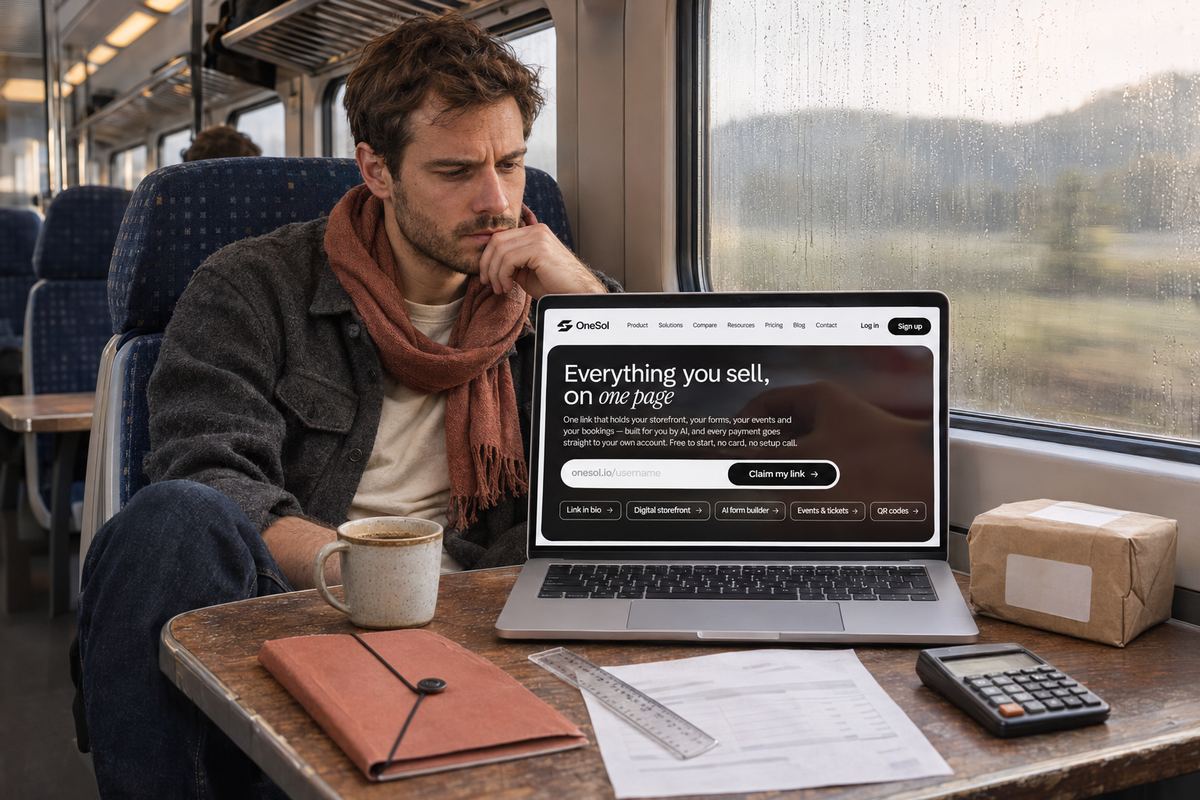
If your sales are scattered across several places, you can sell products, downloads, coaching or class bookings from a free OneSol page through your own Stripe or PayPal account, so every sale lands in one account and your running total for the Kleinunternehmer limit is in one place.